|
|
Casino Royale downrated to BBFC 12A for 2026 cinema release
|
|
|

|
18th October 2026
|
|
|
Thanks to Joseph
|
Casino Royale is a 2006 US/UK/Czech/Germany/Bahamas spy film by Martin Campbell.
With Daniel Craig, Eva Green and Judi Dench.


Originally cut according to BBFC for a 12 rating. The film was also cut in the US but differently for a PG-13 rating. The uncut version was later released on Blu-ray with a 15 rating in the UK and MPAA Unrated in the US. The uncut
version was downrated to BBFC 12A for 2026 cinema release. Summary Notes James Bond goes on his first ever mission as a 00. Le Chiffre is a banker to the world's terrorists. He is participating in a
poker game at Montenegro, where he must win back his money, in order to stay safe among the terrorist market. The boss of MI6, known simply as M sends Bond, along with Vesper Lynd to attend this game and prevent Le Chiffre from winning. Bond, using help
from Felix Leiter, Mathis and having Vesper pose as his wife, enters the most important poker game in his already dangerous career. But if Bond defeats Le Chiffre, will he and Vesper Lynd remain safe?
Cutting Edge
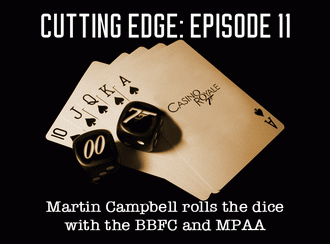
A video and detailed description of the BBFC and MPAA cuts in
Gavin Salkeld's Cutting Edge 11: Casino Royale
See more from
Cutting Edge
Versions

uncut
|
run:
|
144:21s
|
|
pal:
|
138:35s
|
|



|
UK: Uncut and BBFC 12A rated for moderate violence, threat, injury detail, language, sex:
- 2026 Park Circus cinema release (rated 22/09/2026) titled Casino Royale (20th Anniversary Edition)
The BBFC commented (with thanks to Joseph): Over the two decades since the film's original release, audience familiarity with the James Bond series' darker, more grounded tone in the Daniel Craig films
has grown. Contemporary viewers expect a higher degree of threat and intensity in modern action cinema compared to the expectations of 2006 or 2012. Re-assessing the torture scene under current guidelines revealed that while the
extended cut contains a small number of additional close-ups and reaction shots, it does not contain explicit bloodiness, gory detail or sexualised violence. The core elements causing impact, psychological threat and implied pain, remain substantially
similar in tone to the theatrical 12A cut from 2006. The violence occurs within a fantastical spy-thriller setting rather than a realistic domestic or real-world context. Crucially, the scene relies heavily on dialogue and actor
performance rather than graphic visual harm, and the protagonist ultimately survives and prevails, reducing the overall sense of lingering trauma. Under BBFC Classification Guidelines, the restored footage does not cross the
threshold into sustained visual cruelty or graphic injury detail that would require a mandatory 15 rating. Consequently, the 20th anniversary complete international version is classified 12A for moderate violence, threat, injury detail, language, and
sex, bringing it into alignment with the original theatrical release.
UK: Passed 15 uncut for one scene of torture and strong action violence for:
- 2020 MGM (RB) 4K Blu-ray at UK Amazon titled
Casino Royale (Extended Version)
- 2020 MGM Amazon Prime VoD [UK only]
at UK Amazon
- 2015 20th Century Fox RB Blu-ray
at UK Amazon
- 2015 20th Century Fox 23 Films Premium Edition RB Blu-ray
UK Amazon
- 2015 20th Century Fox 23 Films RB Blu-ray
at UK Amazon
- 2015 20th Century Fox 23 Films R2 DVD
at UK Amazon
- 2013 Sony [Daniel Craig Triple Pack] R0 Blu-ray
at UK Amazon
- 2012 MGM R0 Blu-ray [Bond 50 Collection]
at UK Amazon
- 2012 MGM R0 Blu-ray
at UK Amazon titled Casino Royale (Extended Version)
The BBFC noted:
- Additional material in torture scene
The BBFC later commented that not all the cut material was restored. Some material seen during the rough cut stage did not make the final cut, but the UK 15 rated release is now the definitive worldwide version. US: Casino Royale
is uncut and MPAA Unrated:
- 2019 MGM [007 The Daniel Craig Collection] R0 4K Blu-ray at US Amazon
US: Uncut for VoD streaming at Vudu (thanks to Neil)
|

advised
category
cuts
|
cut:
|
|
|
run:
|
144:08s
|
|
pal:
|
138:22s
|
|

|
UK: Passed 12A/12 after BBFC advised category cuts were implemented for:
- 2015 20th Century Fox 23 Films R2 DVD at UK Amazon
- 2013
Sony [Daniel Craig Triple Pack] R2 DVD
- 2012 MGM [22 Film Collection] R2 DVD
- 2007 Sony R0 Blu-ray
- 2007 Sony R2 DVD
-
2006 cinema release
The BBFC commented: Cut on BBFC advice in 2006: This film was originally seen by the BBFC in an unfinished version, for advice as to the film's suitability at '12A'. The BBFC advised the company that the torture scene
placed too much emphasis on both the infliction of pain and the sadism of the villain for the requested '12A' category. When the completed version of the film was submitted for classification, reductions to the torture sequence had been made, including
the removal of lingering shots of the rope, close shots of Bond's facial reaction and the substitution of a more distant shot of the beating compared to the original version. This re-edited version of the scene was considered acceptable at '12A', where
the Guidelines permit violence provided there is no dwelling on detail or emphasis on injuries. Thanks to Floyd: The Region 3 DVD is uncut, but there's nothing graphic in the torture scene. There
are a couple of lingering shots, most notably where Le Chiffre lands the rope gently on Bond's shoulder.
In the cut version when there is a distant shot of him walking around Bond he says 'you've taken care of your body', and then in the next
shot he's swinging the rope before hitting Bond.
In the uncut version however, he lands the rope on his shoulder, and he leans over to him and says, 'such a waste'.
The sound seems to be cut down as well of Chiffre swinging the rope
before striking Bond, but nothing really shocking. It seems that the hopes of an uncut US release are premature. The Irish 15A is the same version as the UK release. It appears that the German version has suffered even
more cuts than the US/UK versions to achieve a 12 rating. Perhaps the uncut version may have to wait on the (inevitable) Directors Cut.
|

cut
|
cut:
|
|
|
run:
|
144:10s
|
|
pal:
|
138:24s
|
|

|
US: The PG-13 rated US region 1 release was cut. Through the use of numerous techniques including small snips, the shifting of edit points and alternative footage, Campbell re-edited the film's opening bathroom fight and the later
stairwell fight to secure a PG-13 rating in the United States.
|
|
|
|
An AI assisted letter writing campaign attempting to pressurise cinemas into not showing the latest Sacha Baron Cohen film
|
|
|
|
|
4th October 2026
|
|
|
See article from dailymail.com
|
Ali G: Who Iz I? is a 2026 UK/US comedy by Sacha Baron Cohen
Starring Sacha Baron Cohen, Morgana Robinson and Stewart Rodeheaver
Hip-hop journalist Ali G returns after 20 years to make a documentary with real people. Cameras follow him for over a year as he takes classes, walks the streets, and appears on shows, often with his pregnant
girlfriend.
The Daily Mail has reported on an AI assisted campaign trying to prevent Ali G: Who Iz I? from being shown at cinemas. Ali G is returning to cinemas in October following a 20-year hiatus during which, as Ali G puts
it, the world went to crap. In the hours that following the release of the movie trailer, a most peculiar series of events played out. It involved a short-lived but apparently extremely high-profile campaign to have Ali G: Who Iz I? banned from
worldwide cinemas. This campaign claimed that the entire film, along with its central character, is somehow racist. Out of nowhere, people who appeared to be offended by Baron Cohens trailer had launched a letter-writing campaign. Before long,
more than 50,000 messages were sent to cinema chains, calling for the film to be blacklisted. The social media accounts of firms such as Odeon were similarly bombarded. Each of 50,000 complaint emails was different. Some were written in the local
language, they had a variety of subject lines and, while none were exactly the same length, many were extremely detailed. The attempt to cancel Baron Cohen was in fact a highly organised Ai assisted campaign. It was also very well financed. The
campaign was apparently orchestrated via an internet platform named NewsCord, which devotes most of its resources to opposing Israel. A NewsCord user wishing to join the campaign against Sacha Baron Cohen needs only to enter their own email address in a
box. The website will then create 20 unique complaint AI assisted emails in their name and send them out to cinema chains and the BBFC.
|
|
|
Campaigners hype new movie Ali G: Who iz I?
|
|
|
|
|
31st August 2026
|
|
|
See article from
dailymail.com
|
Ali G: Who Iz I? is a 2026 UK/US comedy by Sacha Baron Cohen
Starring Sacha Baron Cohen, Morgana Robinson and Stewart Rodeheaver
Hip-hop journalist Ali G returns after 20 years to make a documentary with real people. Cameras follow him for over a year as he takes classes, walks the streets, and appears on shows, often with his
pregnant girlfriend.
It's been a while since anybody has called for a movie to be banned in UK cinemas but an obscure group is campaigning against Ali G: Who iz I? claiming that it is enforcing racist stereotypes. The
Amazon MGM film is due for release in cinemas on October 23. Baron Cohen released the first trailer for Ali G: Who Iz I? last week, marking his return to the satirical character after a 20-year absence. The actor, in his directorial debut, filmed
the movie secretly over the course of a year with the mockumentary following his character's life since the world went to crap, alongside his pregnant girlfriend, played by Morgana Robinson. A day after the trailer's release, NewsCord, a UK news
comparison and media monitoring platform, started a campaign urging cinemas around the world to refuse to screen the film. The campaign group have said they have emailed 15 major chains globally. As of Sunday, the campaigners claim they have been
instructed to send 41,000 emails on behalf of its website readers. The campaign group said: Ali G is a cover to laugh at Jamaican culture. The character enforces harmful stereotypes of how a Jamaican man behaves in
society. Ali G smokes weed, is a misogynist, and does nothing meaningful in life. He does this because he thinks this is what a Jamaican does. The world laughs at Ali G. But the real butt of the joke are
Black people and specifically Jamaicans, they added. This is evident in a number of Baron Cohen's films, where a race or religion is the victim of the "joke".
Phil Clapp, head of the UK Cinema Association, told Variety in
response to the campaign: Cinemas are there to engage and entertain the widest possible audience. They are not there to act as censors or arbiters of public taste. So where a film has been given a
certificate by the BBFC, they will decide whether or not to play it solely with the likely response of their audience in mind.
A defiant Baron Cohen himself also addressed the growing backlash, writing on X:
In an age where a comedian's career can be ended by a single un-PC joke, I thought I'd play it safe and bring this guy back.
Comment: The Ali G haters are the dumbest people alive 1st September 2026. See article from spiked-online.com by
Brendan O'Neill
|
|
|
Human Centipede 2 has been banned again by the Australian Censorship Board
|
|
|
|
|
23rd August 2026
|
|
|
See refused-classification.com
|
The Human Centipede II (Full Sequence) is a 2011 Netherlands/UK horror by Tom Six.
With Laurence R Harvey and Ashlynn Yennie.


Famously banned in the UK for 2011 DVD but later passed 18 after heavy cuts. Also temporarily banned in Australia before later being passed R18+ with cuts. An uncut version was again banned in 2026. In June 2026, Umbrella
Entertainment announced an uncensored 4K UHD Collector's Edition of THE HUMAN CENTIPEDE TRILOGY would be released on 22 October. In July, the uncut version was awarded an R18+ (High impact themes, blood and gore, violence, sexual violence, nudity and
sex scenes) as an Accredited Classifier Decision. The Classification Board are able to revoke and overturn a decision made by a classification tool or accredited classifier if it believed it would have determined a different rating or the consumer
advice was misleading, incorrect or grossly inadequate. This is what has now occurred, with the R18+ being replaced by an RC on 21 August. It is the first time a film has been banned in such a way since the March 2024 introduction of Accredited
Classifier system. A cut version was released in the US Unrated by the MPAA. Later it was released in the uncut version which is now cheekily tagged as the Director's Cut, still MPAA Unrated. The film was also banned in New Zealand.
Summary Review: Sick Fantasy Inspired by the fictional Dr. Heiter, disturbed loner Martin dreams of creating a 12-person centipede and sets out to realize his sick fantasy. This is the
type of movie you will either like or hate, I doubt there will be much in between. The film is quite shocking, but not the most outrageous of the genre. Actor Laurence R Harvey is masterful as Martin yet doesn't utter a single
word of dialogue.
|
|
|